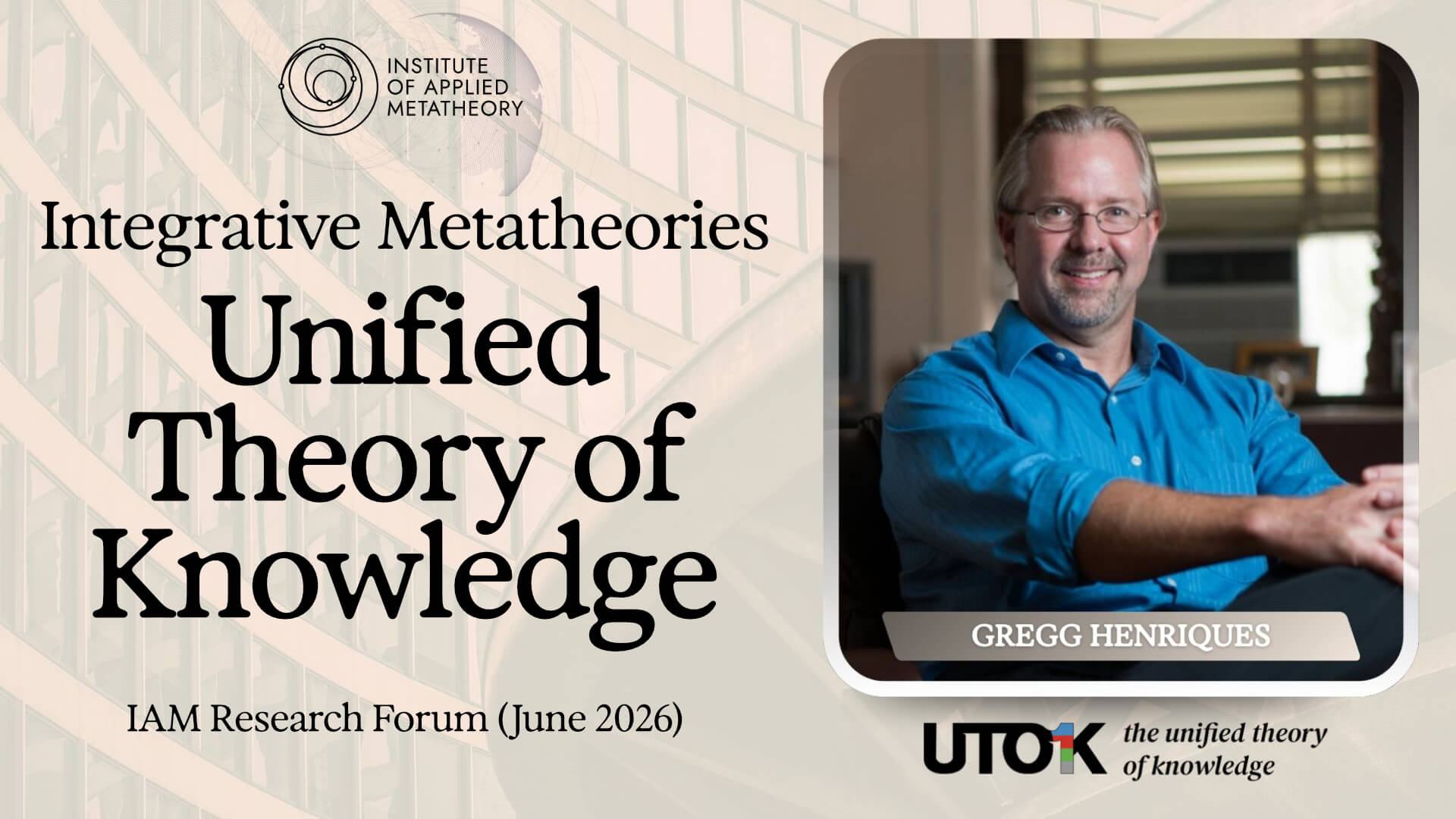
Modern science has produced an increasingly sophisticated picture of the physical world. Where it has persistently struggled is in placing mind and consciousness within that picture. Gregg Henriques calls this the Enlightenment Gap, and he argues it sits at the root of the metacrisis.
In this IAM Research Forum session, Dr. Henriques presents the Unified Theory of Knowledge (UTOK) as a natural philosophy built to close that gap. His diagnosis begins with what he calls gist ontology: we share a basic working picture of what matter is and what life is, yet we lack any comparable picture of mind. UTOK’s response pairs a transjective epistemology with a coherent naturalistic ontology. Scientific knowing operates alongside subjective experience and cultural meaning-making, each irreducible to the others, while the Tree of Knowledge system reorganizes the sciences around the successive emergence of matter, life, mind, and culture.
Psychology turns out to be the linchpin: the sciences cohere up to neuroscience, then fracture exactly where psychology should stand, and that fracture is what has kept the Enlightenment Gap open. Dr. Henriques closes with UTOK’s metapsychology and his new RAFTing model, which treats mind as a process ontology: the animal body is the raft, and mindedness is the activity of rafting it through the world. The discussion then takes up realism about the intersubjective domain, the questions UTOK leaves open, and what it contributes alongside integral theory and critical realism to building an ecology of integrated metatheories.
Timestamps
00:00:02 – Introduction: Dr. Gregg Henriques and UTOK
00:04:03 – The Enlightenment Gap
00:08:51 – The Central Question for Integrative Metatheory
00:20:55 – UTOK’s Philosophy: Descriptive Metaphysics and Epistemology
00:27:57 – The Tree of Knowledge System
00:39:18 – The Problem of Psychology
00:52:32 – Metapsychology and the RAFTing Model
01:01:02 – Discussion: UTOK and the Ecology of Metatheories
