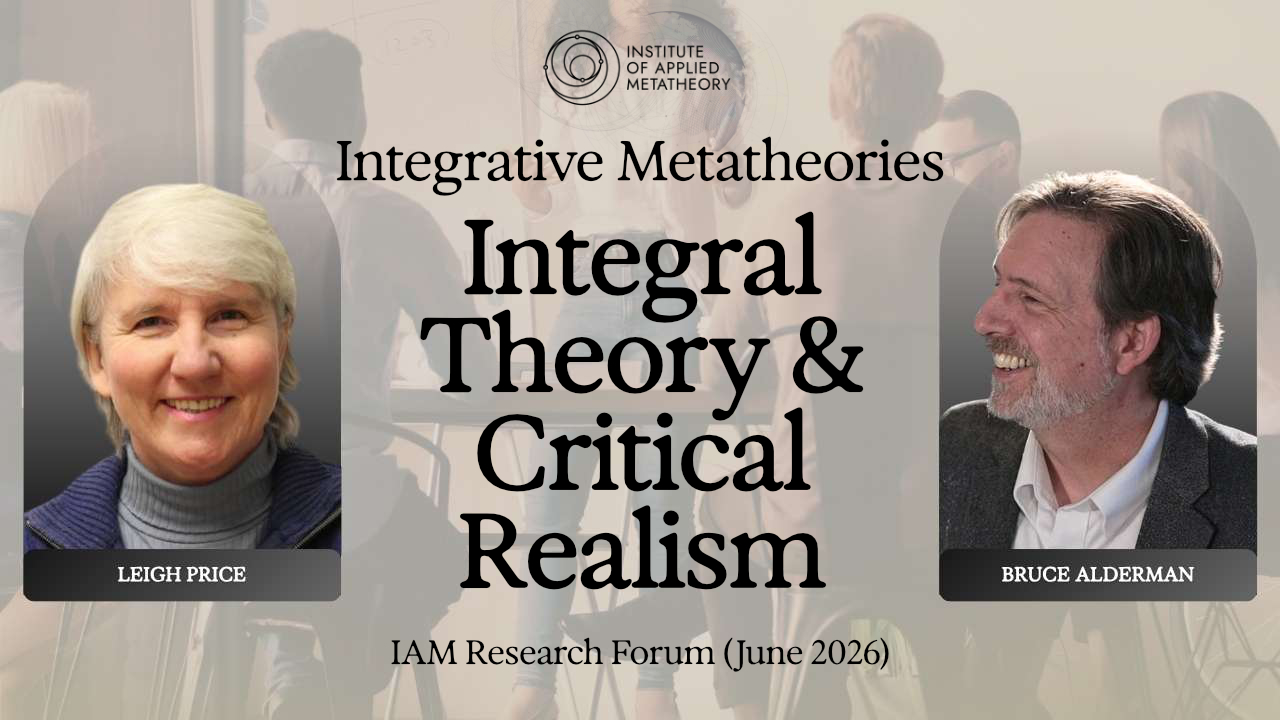
What is actually real, and how do we know it? Roy Bhaskar built a philosophy of science arguing that reality runs deeper than what we can observe, with real structures and causes behind the events we see, and made that philosophy the engine of an emancipatory politics. Ken Wilber built a map of the different ways people grow, know, and experience the world. This IAM Research Forum session brings scholars of both traditions, critical realism and integral theory, into direct dialogue.
Leigh Price, who worked directly with Bhaskar and now directs the Roy Bhaskar Centre, walks through his ideas in five stages, from his account of what’s real versus what’s merely observed, through his model of how individuals and society shape each other, to the emancipatory and even spiritual turns his thinking eventually took.
Bruce Alderman, an Associate Director of the Blue Sky Leaders Program at the California Institute of Integral Studies, traces what happened to Wilber’s four-quadrant map, and the many scholars who revised, corrected, and extended it. He then shares his own contribution: a way of reading any big framework by the grammar it’s built on, and a concept called “heno-ontology” for how frameworks like these can hold each other up without any one swallowing the rest.
The two ideas meet directly when Price and Alderman work through a shared example (a set of cutlery) that shows their frameworks converging on the same insight from different directions. From there the conversation turns to a bigger question: what would it look like for frameworks like these to actually work together, and how do you make ideas this rich usable for people who aren’t scholars.
Timestamps
00:00:00 – Meet the Speakers
00:03:26 – Roy Bhaskar’s Life and the Origins of Critical Realism
00:16:13 – What’s Real vs. What We Observe
00:30:12 – How Individuals and Society Shape Each Other
00:34:03 – The Emancipatory and Spiritual Turns
00:36:56 – Ken Wilber’s Map, and Where People Took It Next
01:00:45 – A Framework for Reading Any Big Idea
01:11:22 – The Two Ideas Meet: A Shared Example
01:16:22 – Can These Frameworks Work Together?
01:19:00 – Making Big Ideas Usable for Everyone
