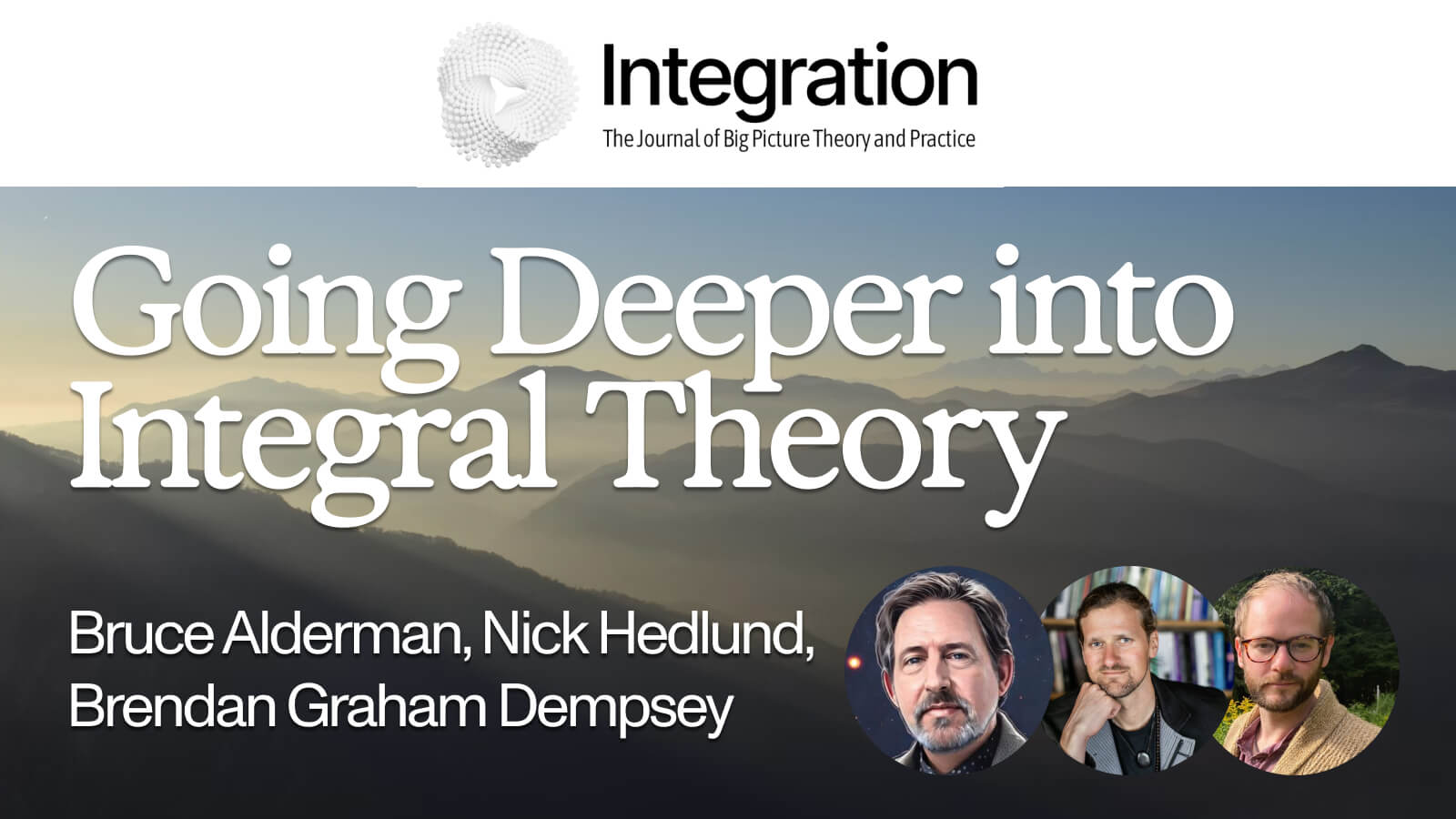
In this episode of the Integration podcast, Bruce Alderman returns for a deeper look at integral theory, continuing the conversation he opened at the IAM Research Forum. Joined by Brendan Graham Dempsey and Nick Hedlund, he traces Wilber’s path into integral theory from its roots in transpersonal psychology through the five moving parts of the AQAL model: quadrants, levels, lines, states, and types.
Alderman then turns to where the model runs thin. He walks through its weak connection to evolutionary biology and philosopher Mark Edwards’ critique that integral quietly conflates the individual and the collective, tracing how a framework built to hold everything together can end up flattening real differences.
Yet Alderman argues these limits open onto something generative. He introduces his own toolkit for reading any big framework: a lightly-held approach to categories he calls the “a-categorical imperative,” and “heno-ontology,” a way of letting frameworks like integral theory and critical realism each hold their own ground without one swallowing the rest.
The episode closes on a question left open for the whole Integrative Metatheory 2.0 project: one new synthesized map, or several frameworks working side by side?
Listen on your favorite podcast app
Timestamps
00:00:00 – Introduction
00:01:41 – A Primer on Wilberian Integral Theory: From Transpersonal Roots to AQAL
00:16:05 – Where the Model Runs Thin: Science, Evolution, and Mark Edwards’ Critique
00:22:05 – Mapping What Came After Wilber
00:29:24 – Inside Bruce’s Grammar for Reading Big Ideas
00:44:00 – Heno-ontology: Holding Multiple Frameworks at Once
00:48:00 – Pushback: Does This Flatten Ontology and Epistemology?
00:54:47 – One Map or Many? The Open Question for Integrative Metatheory 2.0
01:17:56 – Closing Thoughts and What’s Next
