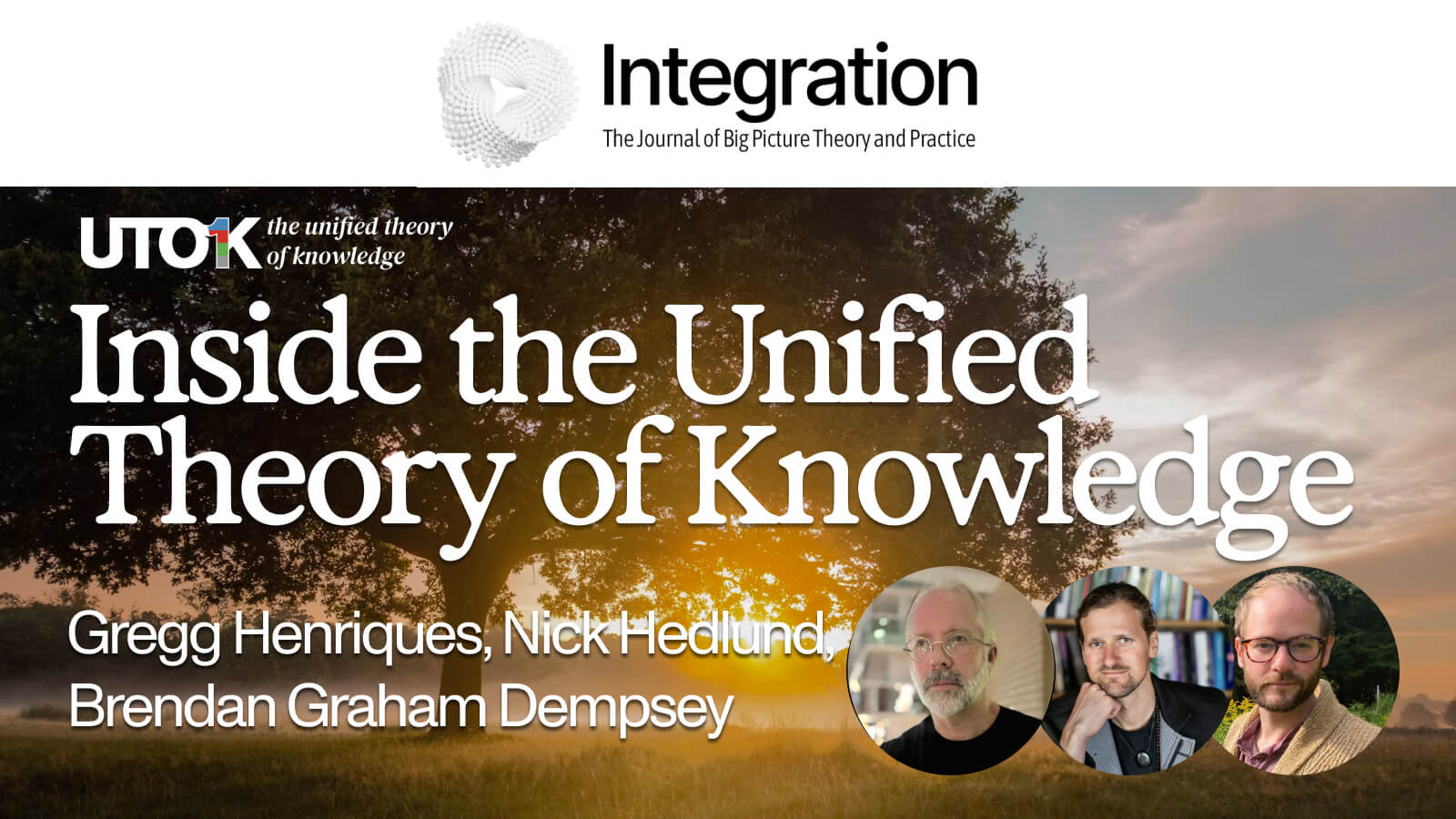
In this episode of the Integration podcast, Dr. Gregg Henriques joins Brendan Graham Dempsey and Nick Hedlund for a deeper dive into the Unified Theory of Knowledge. His earlier presentation at the IAM Research Forum established the philosophical context; this conversation goes inside the model itself.
Key themes include the Tree of Knowledge in depth: the four cones of complexification and how matter, life, mind, and culture emerge as distinct information-processing domains. The conversation also takes up two levels of consciousness and what UTOK has to say about panpsychism, before turning to the RAFTing model (Relating, Acting, Feeling, Thinking) as a practical framework for psychology. Dr. Henriques closes by reflecting on UTOK’s limits and what it stands to gain from engagement with other metatheories.
Modernity’s greatest achievements came without a coherent worldview to guide them. Without an adequate foundation for what is real and what we value, coordinating at the scale we now inhabit remains an open problem. That, Dr. Henriques argues, is precisely what UTOK is working to address.
Listen on your favorite podcast app
Timestamps
00:00:00 – Introduction: Continuing the UTOK Conversation
00:02:52 – Unpacking the Tree of Knowledge Diagram
00:15:15 – The Emergence of Mind: From Organism to Culture
00:32:12 – UTOK and Consciousness
00:46:05 – The Hard Problem and Perspectival Epistemic Portal
00:55:10 – The RAFTing Model as Applied Psychology
01:09:07 – The Real-World Stakes of Metatheory
01:09:33 – UTOK’s Limits and What It Still Needs
